

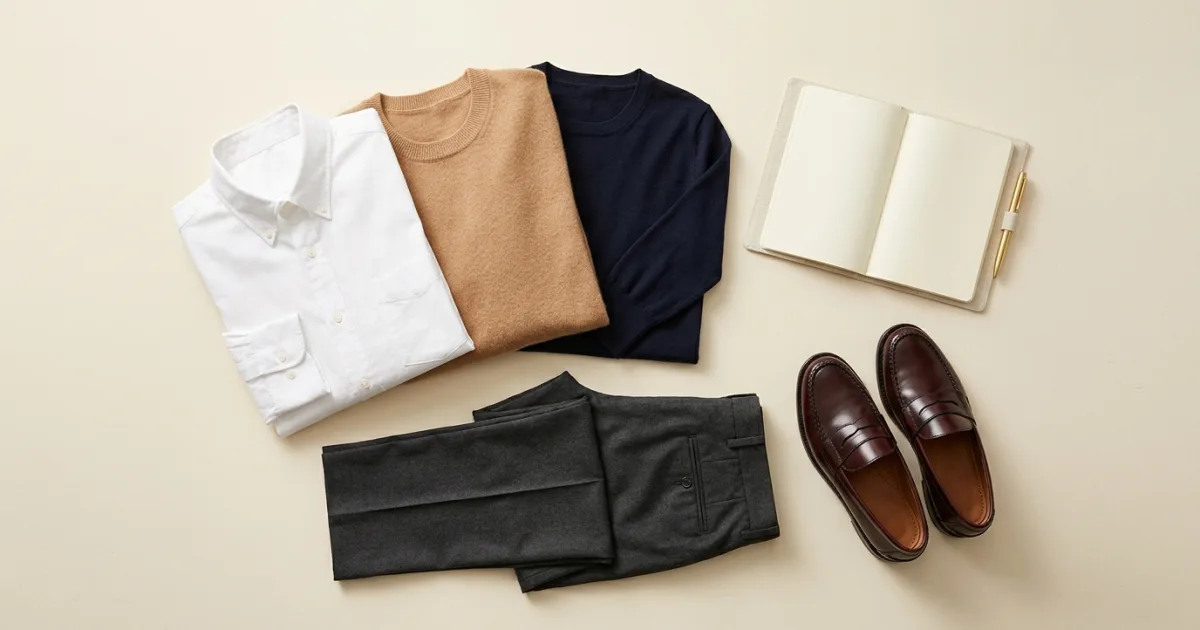
Planning a week means settling the hardest day first and letting the easy ones follow, with one alternative for the weather.
The hardest day usually hangs on a single piece, such as the interview blazer or the boots for a long walk. Pin that piece in the Wdrobe app and the stylist suggests outfits around it and the forecast.
What a week's plan is worth
Decide what the plan is meant to save: time, repetition, or the panic on the difficult day. Fifteen minutes is the realistic budget.
Plan the week in front of you rather than a repeatable template. Templates break on the first unusual day.
Five steps on a Sunday
1. Check the calendar and weather together before opening the closet
Open the calendar and the forecast together, because either one alone produces a plan that fails. The forecast changes the shoes and the calendar changes everything above the waist.
2. Assign the most restrictive dress code or activity first
Whichever day has the strictest dress code or the most walking gets decided first. Solve the interview or the long walk first and the other four days fall out easily.
Planning seven different outfits is why weekly planning collapses. Two formulas and a few swaps survive a real week. Set up the two.
3. Use two reliable outfit formulas across several days
Two outfit formulas you trust will cover most of the week without feeling repetitive. Two formulas across five days is not repetitive if the layer or shoe changes.
4. Prepare weather and energy-level alternatives without doubling the plan
Keep one warmer and one cooler option rather than building a second full plan. One warmer and one cooler option is the difference between a plan and a wish.
5. Confirm laundry, footwear, bags, and outerwear the evening before
Check laundry, shoes, bag and coat the evening before, which is where most plans actually fail. Most failures are a shirt in the wash rather than a bad decision.
Compare the plan with the week
At the end of the week, note where you deviated. The deviation usually points at a constraint you forgot rather than a failure of nerve.
If the same day keeps breaking, write the function that would fix it before shopping for anything.
Frequently asked questions
Do I need to catalog everything?
No. Begin with the part of the wardrobe relevant to the weekly outfit planning goal. Expand only when the added information will support an outfit, care, storage, or purchase decision. Completeness is not the goal.
How often should I repeat this process?
Repeat the weekly outfit planning process when the underlying conditions change or the same problem returns. A move, new job, different climate, trip, or season is a useful trigger. An arbitrary reset usually creates more maintenance than insight.
Continue with this related wardrobe guide and adapt the weekly outfit planning method to your own schedule rather than a generic ideal.
Weekly planning works until the one morning you skip it, so the setup needs to be fast enough to repeat. Build a week you will not abandon by Wednesday to build a week from clothes you already own in a single sitting.